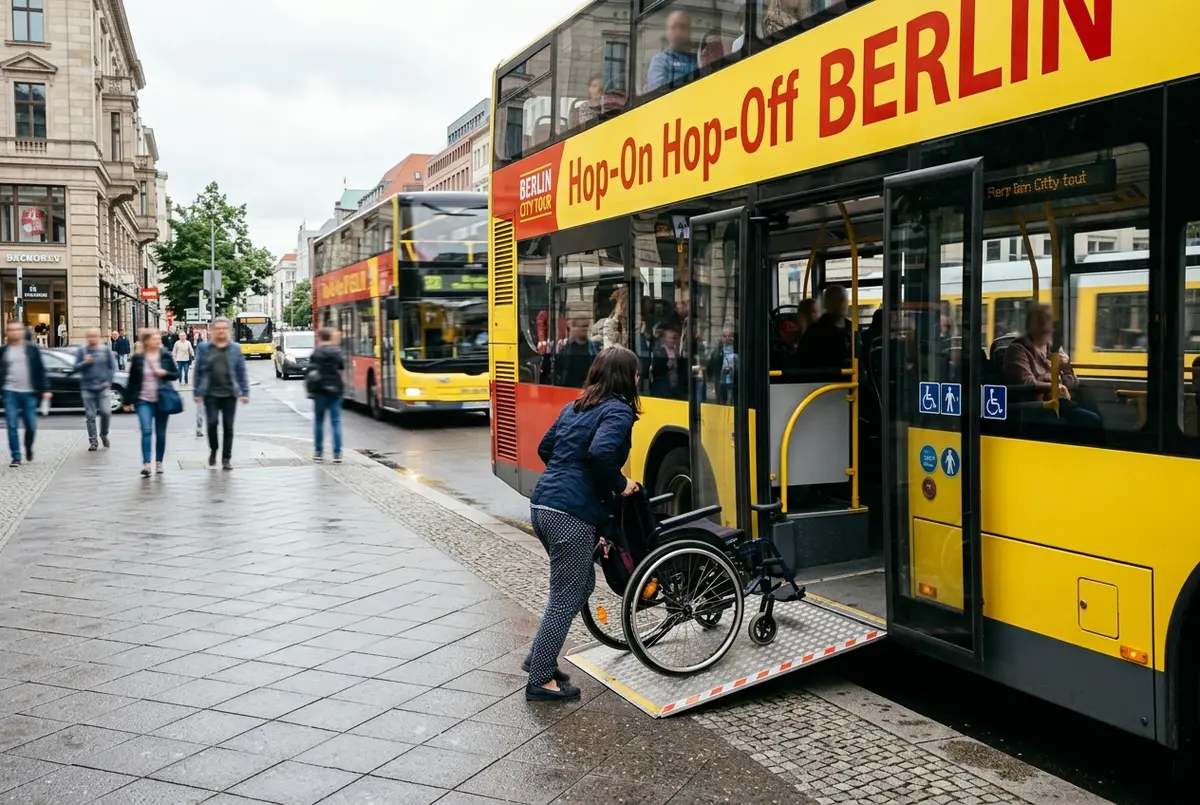
Berlin hop on hop off bus wheelchair accessible questions come up a lot, and I think that’s because most tour listings gloss over the details that actually matter. Here’s what I’d actually want to know before booking: what the lower deck offers, what the upper deck doesn’t, and where luggage and prams fit into all of this.
If accessibility or luggage space is the deciding factor for your trip, it’s worth checking this against my complete route and stop guide first, since the loop structure itself affects how much walking you’ll do between stops regardless of the vehicle.
Is the Berlin Hop-On Hop-Off Bus Wheelchair Accessible?
Mostly, yes, on the lower deck. Most operators run low-floor vehicles with a step-free entry and a designated wheelchair space near the door, so boarding itself is usually straightforward. What it doesn’t cover is the open-top upper deck, which is reached by a narrow interior staircase on nearly every vehicle.
I’d call this the single most important thing to understand before you book: the photogenic open-top experience that makes this tour appealing is, on most buses, simply not reachable by wheelchair. If the upper deck view is the main reason you wanted this ticket, I would weigh that disappointment honestly before paying for it.
What Does the Lower Deck Actually Offer?
The lower, covered deck is where the step-free entry and designated wheelchair space usually sit, often near the front by the driver or just inside the main door. You still get the full route and the recorded or live commentary, just through glass rather than open air.
I’d say the lower deck is a genuinely solid experience on its own, not a consolation prize. You see the same landmarks, ride the same loop, and stay dry if it rains, which the upper deck can’t claim on a bad-weather day anyway.
Can You Bring a Pram or Stroller on Board?
Generally yes, though space is limited and depends on how busy that particular bus is at the time you board. A collapsible pram is almost always easier to manage than a full-size one, and crew members will usually help you fold and stow it if the aisle is tight.
I would collapse the pram before boarding rather than trying to manage it on the step, since that’s the moment that actually slows down boarding for everyone behind you in the queue. A lightweight umbrella stroller makes this whole process meaningfully easier than a bulky travel system.
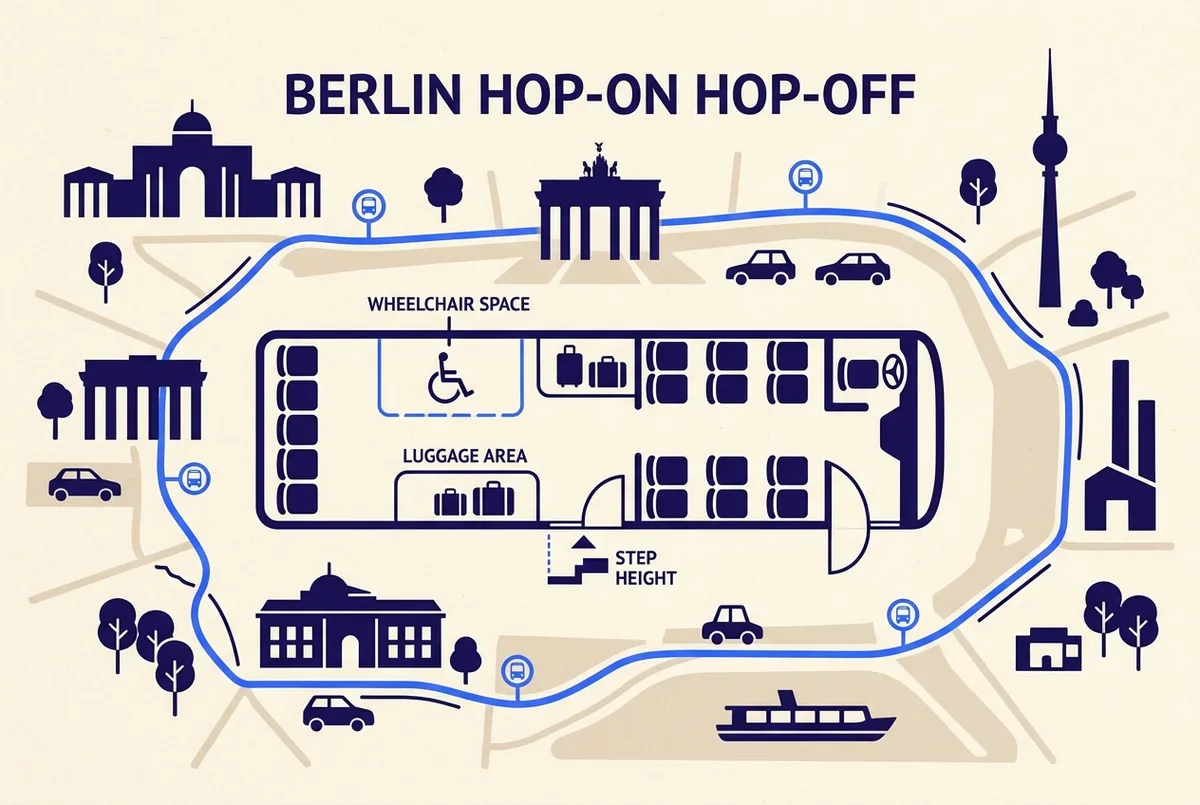
Is There Luggage Storage on the Hop-On Hop-Off Bus?
This is the honest answer most listings skip: hop-on-hop-off buses are not built for suitcases. There’s no dedicated baggage hold like a long-distance coach, so you’re generally limited to whatever fits at your feet or on your lap, which means a day bag or small backpack works fine but a large suitcase does not.
I would never bring checked-bag-sized luggage onto this tour. If you’re arriving straight from the airport or train station with real bags, I’d drop them at your hotel first or use a short-term luggage storage service near your first stop, then ride the bus unencumbered.
Are Double Decker Buses Safe?
Yes, and this is a fair question if you’ve never ridden one. A double decker bus berlin tour runs on vehicles purpose-built for exactly this kind of sightseeing route, with secured upper-deck seating, safety rails and crew who close the open deck in genuinely bad weather like high wind or lightning.
I wouldn’t worry about ordinary rain or cold. I would take it seriously if a crew member tells you the upper deck is closed for the day, since that call is almost always about wind strength at height rather than caution for its own sake.
How High Is the Step Getting On and Off?
Most low-floor vehicles keep the entry step close to curb height, which is noticeably easier than climbing onto a standard coach. That said, step height can vary by operator and even by which door you use, so it isn’t perfectly uniform across every bus on the network.
I’d ask the crew member at the door if a lower step matters to you specifically, since they board dozens of people a day and know exactly which entrance on their vehicle is easiest. It takes five seconds to ask and can save you an awkward moment.
What About Service Animals and Pets?
Service animals are generally welcome on board without issue, and on the main Big Bus route, even non-service dogs are allowed, though large dogs are required to wear a muzzle and stay on the lower deck rather than climbing to the open top. That’s a real, specific rule worth knowing if you’re traveling with a pet rather than a service animal.
I’d call ahead or check the listing for your exact ticket if you’re bringing any animal, since policies can differ slightly between the different route operators even though the general approach is similar across the city.
Is There an Accessible Toilet on Board?
No, and this catches people off guard. Hop-on-hop-off buses don’t carry an onboard toilet of any kind, accessible or otherwise, since the loop is built around frequent stops rather than a long continuous ride. Every route passes multiple hop-off points with cafes, museums or public facilities nearby.
I would plan toilet breaks around your hop-offs rather than the bus itself, and I’d specifically scout which stops sit closest to a cafe or museum entrance if a quick, reliable facility matters to your plan. This is one of those small logistics details that’s easy to overlook until you actually need it.
Can You Transfer Between Routes If You Have Limited Mobility?
Yes, and this is actually one of the format’s advantages for travelers managing a mobility constraint. Because the ticket is valid for the full loop rather than one scheduled ride, you can stay on board through a stop you don’t want to visit instead of forcing a transfer, then hop off only where the walk from the curb is manageable.
I’d use this flexibility deliberately. Rather than planning to visit every stop the way a fully able-bodied traveler might, I would scout ahead using the route map for which landmarks sit closest to where the bus actually parks, and build your day around those rather than the ones requiring a longer walk from the curb.
Does Accessibility Change Which Ticket You Should Book?
It can, yes. If step-free access and luggage space matter more to you than the open-top view, I’d lean toward whichever option has the most recent, most detailed accessibility notes rather than assuming every ticket on the network behaves identically. My worth-it breakdown covers how this kind of constraint shifts the whole value calculation.
I would also factor in ticket length here. A 24 vs 48 hour comparison matters more if mobility means you’ll move slower between hop-offs and want the extra day as a buffer rather than a bonus.
Does Timing Affect How Easy Boarding Is?
Yes, more than people expect. Buses are least crowded earlier in the day, which makes finding space for a wheelchair, pram or luggage meaningfully easier than trying to board a packed afternoon departure. My best time to ride guide breaks this down hour by hour.
I would specifically plan an earlier start if accessibility is a concern, since a quieter bus gives the crew more room to help you board properly instead of rushing to keep a crowded stop moving.
What Should You Ask Before You Book?
I’d ask three things directly: whether the specific vehicle on your route has a low-floor entry, whether there’s a dedicated wheelchair space rather than just “step-free boarding,” and what the realistic luggage limit is for your situation. Generic marketing copy rarely answers all three, so a direct question to the operator or a quick look at recent reviews mentioning accessibility tends to tell you more than the listing itself.
I would treat a vague or missing answer as useful information on its own. If an operator can’t tell you clearly how their accessibility setup works, that uncertainty is worth factoring into your decision.
My Honest Recommendation
Book with real confidence if you need step-free boarding and a wheelchair space on the lower deck, since that part of the experience is genuinely well handled on most Berlin routes. Go in with clear expectations if the open-top upper deck was the main draw, since stairs are the norm there, and skip this format entirely if you’re traveling with full-size luggage rather than a day bag.
For context on what accessible public transport generally looks like beyond this one tour format, Wikipedia’s overview of the low-floor bus explains the design standard most operators are working from. And if you want to compare every option on this site before deciding, my homepage breakdown of every Berlin hop on hop off ticket is the next page worth checking.
Frequently Asked Questions
Is the Berlin hop-on hop-off bus wheelchair accessible?
The lower deck usually is, with a low-floor entry and a designated wheelchair space. The open-top upper deck is reached by stairs and generally isn’t.
Can you bring a suitcase on the hop-on hop-off bus?
Not comfortably. There’s no dedicated baggage hold, so stick to a day bag or small backpack and store larger luggage elsewhere before riding.
Is it safe to ride the open-top upper deck?
Yes, the vehicles are purpose-built for sightseeing with secured seating, and crews close the upper deck in genuinely bad weather for safety.
Are prams allowed on board?
Generally yes, though a collapsible pram is much easier to manage in the aisle than a full-size stroller.
Are dogs allowed on the hop-on hop-off bus?
On the main route, yes, though large dogs must wear a muzzle and stay on the lower deck rather than the open top.