Berlin Hop-On Hop-Off Bus Routes & Stops: How It Works
See prices From 23 EUR · Free cancellation available
Contents
The berlin hop on hop off bus route works the same way across every operator in the city: a fixed loop of landmark stops, a bus that keeps circling that loop all day, and a ticket that lets you get on and off as many times as you want within its validity window. Here’s what I’d actually want to know before picking a stop to start from: how long the full loop takes, how often buses actually show up, and which stops are worth the walk.
You buy one ticket that covers a set number of hours, usually 24 or 48, and it’s valid on a continuous loop, not a single one-way trip. Board at any stop, ride as far as you like, then step off whenever something catches your eye. When you’re ready to move again, walk back to the same stop and wait for the next bus on that line.
I’d call this the single most useful thing to understand before your first ride: the clock on your ticket starts the moment you activate it, usually by scanning a QR code or showing a voucher to the crew, not from when you bought it online. Hop on hop off berlin route tickets are built around flexibility, so there’s no penalty for skipping a stop entirely or doubling back to one you already saw.
Check prices & dates
Ready to visit?
Book your tickets in advance: popular time slots sell out.
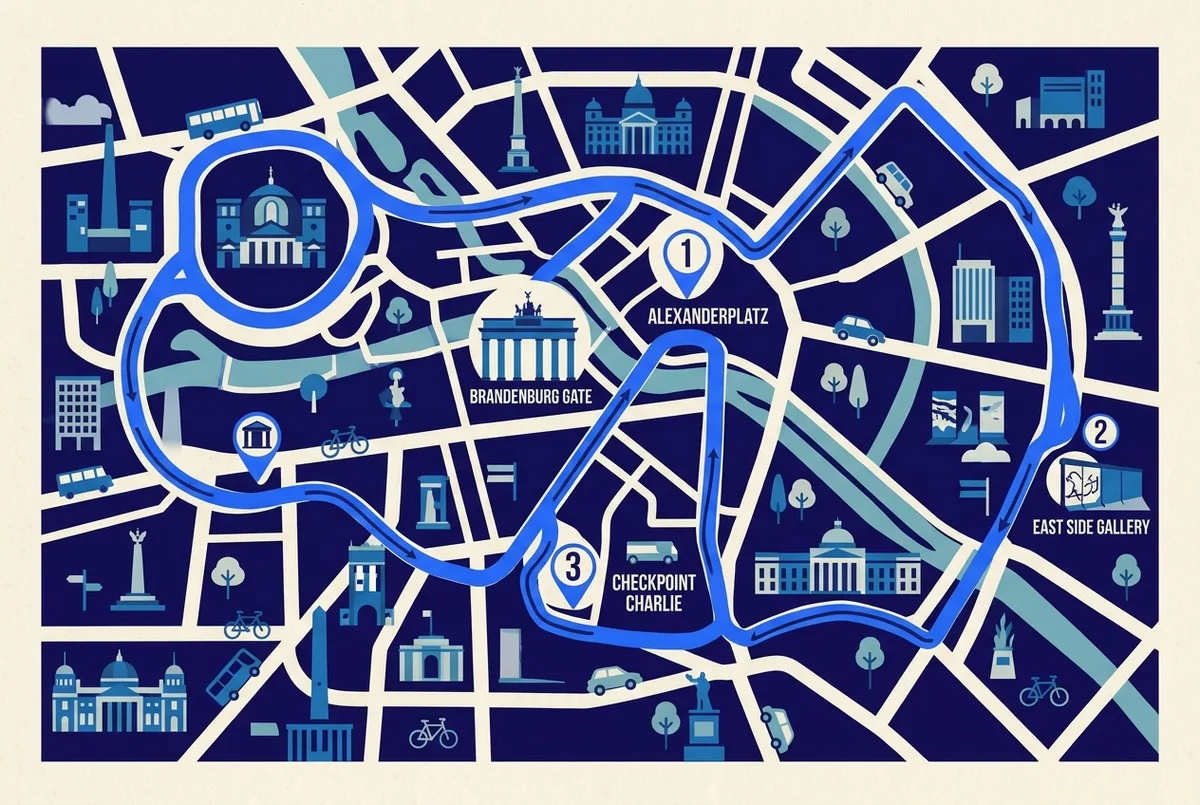
Most Berlin hop-on-hop-off networks run two main lines that split the city roughly in half. A central loop covers the dense core: Alexanderplatz, Museum Island, the Brandenburg Gate, the Reichstag, Checkpoint Charlie and Gendarmenmarkt. A second, eastern loop usually swings further out toward the East Side Gallery and sometimes Friedrichshain, since that stretch of the former Wall sits a bit apart from the central sights.
I’d pick the central loop first if you’re only doing one day, because it carries almost every landmark a first-time visitor actually wants. The eastern loop earns its place on a second day, or if the East Side Gallery specifically matters to you.
How Often Do the Buses Come Around?
In peak season, expect a bus roughly every 10 to 20 minutes on the busier central loop, with slightly longer gaps on quieter secondary routes or in the shoulder months. That gap matters more than it sounds, because it’s the real limit on how many stops you can realistically fit into a day.
Here’s the math I’d actually do: if your loop takes about 2 to 2.5 hours end to end and you want to hop off at four or five stops, budget 30 to 45 minutes at each one and you’ll burn most of a day. I wouldn’t try to cram in more than that on a single ticket without feeling rushed.
Where Are the Best Stops to Hop Off?
Berlin hop on hop off map layouts vary slightly by operator, but a handful of stops earn a hop-off almost every time: Alexanderplatz for the TV Tower and a central starting point, the Brandenburg Gate and Reichstag together since they sit a short walk apart, Checkpoint Charlie with Gendarmenmarkt nearby for a coffee break, and the East Side Gallery if your route reaches it.
My honest take is that Kurfürstendamm, usually near the western end of the main loop, is worth saving for the end of the day rather than an early stop, since it’s shopping and dinner territory rather than a sightseeing priority. Build your stops around the morning for monuments and the afternoon for that kind of wind-down.
What Is the Open Top Deck Actually Like?
It’s the main reason to book this over a standard city bus. The upper deck on a double decker bus berlin tour is open to the sky on most routes, which means better photos and a genuine sense of the skyline that a ground-level view just doesn’t give you. Expect wind, and in direct sun, expect it to get hot fast in summer.
I would bring a light jacket even on a warm day, because the open deck feels noticeably cooler than street level once the bus gets moving. If it’s raining, most buses have a covered lower deck as a backup, so a shower doesn’t have to end your day.
Are Double Decker Buses Safe?
Yes, and this comes up more than you’d expect. Are double decker buses safe is a fair question for anyone who hasn’t ridden one, and the honest answer is that these vehicles are purpose-built for exactly this kind of sightseeing route, with secured upper-deck seating and crew who close off the open deck in genuinely bad weather like high wind or lightning.
I wouldn’t worry about standard rain or cold. I would take it seriously if a crew member tells you the upper deck is closed for the day, since that call is usually about wind strength on elevated roads rather than caution for its own sake.
How Does Weather Affect the Route?
Light rain rarely shuts anything down since the lower deck stays covered and dry. What actually changes the experience is wind, since an open-top deck at speed in a strong gust is a different thing than standing still, and operators will sometimes restrict upper-deck access on genuinely windy days for safety rather than comfort.
I’d check the forecast the morning of your ride rather than days ahead, since Berlin’s weather shifts quickly and a clear forecast two days out can still turn. If it does rain, the lower deck view still covers the same stops, just through glass instead of open air.
What Is the Audio Guide Actually Like?
Most routes play a recorded multilingual commentary through onboard headphone jacks or speakers, triggered by GPS as the bus passes each landmark, so the story you hear usually lines up with whatever you’re looking at out the window. Language counts vary by operator, but a dozen or more options is typical, which covers most travelers without anyone needing to share a single narration track.
I’d rate the recorded commentary as genuinely useful background rather than essential listening. If a live guide matters more to you than route coverage, that’s a real tradeoff worth making deliberately rather than assuming every ticket works the same way, since some operators swap the recording for an actual person narrating in two languages instead.
How Much Walking Is There Between Stops and Sights?
This catches people off guard more than almost anything else. A stop marked on the map isn’t always right outside the landmark. Checkpoint Charlie’s stop, for example, usually involves a short walk to actually reach the preserved guard post and museum displays, and the Brandenburg Gate stop often means crossing a wide plaza before you’re standing under it.
I’d budget 5 to 10 minutes of walking at most stops beyond just stepping off the bus, and more at anything with queues, like a museum entrance. None of this is a flaw in the route. It’s just the reality of a city where major landmarks sit across open squares rather than right at the curb.
Do You Need to Book a Specific Time Slot?
No, and this is one of the format’s real advantages over timed-entry museum tickets. Hop-on-hop-off tickets activate whenever you first board, not at a preset hour, which means you can sleep in, adjust around weather, or start your day with breakfast and still get the full ticket duration you paid for.
I would still activate your ticket earlier rather than later on the day you plan to ride, simply because starting at 9am instead of 1pm gives you meaningfully more usable hours before the last bus of the day stops running the loop.
What Happens If You Miss the Last Bus?
Each route runs on a published daily schedule, typically finishing somewhere in the late afternoon or early evening depending on the season, and once the last bus passes a stop, that’s it until the following morning if your ticket still has validity left. This is the one scheduling detail I’d actually write down before you set off for the day.
I would treat the last-bus time as a hard deadline rather than a rough guideline, especially if your final stop of the day is further from your hotel than you’d want to walk. Public transport is always a fallback if you do miss it, but it defeats part of what you paid for.
Which Ticket Length Actually Fits Your Plan?
This is where the route and the ticket decide each other. A 24-hour ticket covers one full day if you start reasonably early, while a 48-hour ticket lets you split the same network across two mornings, which I think suits anyone balancing the bus against museums or a day trip. My 24 vs 48 hour ticket breakdown walks through exactly how much extra ground the longer option covers.
Price plays into this too, and it isn’t always obvious what a given fare actually includes until you compare options side by side, which my ticket price breakdown covers in more detail than I can fit here.
Is Riding the Bus Actually Worth It?
I think it depends heavily on how you’d otherwise get between sights. If you’d be walking long distances or figuring out unfamiliar transit, the time saved is real. If you’re already comfortable with Berlin’s U-Bahn and S-Bahn network, the calculation shifts, and my honest worth-it breakdown weighs both sides without the sales pitch.
When Should You Actually Board?
Timing changes the experience more than most guides admit. An early start beats the crowds at the Brandenburg Gate and gets you a seat on the open deck before it fills up, while a later start trades that quiet for warmer weather. My best time to ride guide breaks down the full tradeoff hour by hour.
What If You Need Step-Free Access or Have Luggage?
Not every stop and not every bus handles wheelchairs, prams or large bags the same way, and this is genuinely worth checking before you commit to a ticket rather than discovering a problem at the curb. My accessibility and luggage guide covers what to expect and what to ask about in advance.
Is the Route Good for Families with Kids?
Generally yes, and I think it’s one of the better formats for traveling with children precisely because nothing is fixed. A tired or restless kid doesn’t derail the whole day the way it would on a guided walking tour with a set pace, since you can hop off early, grab a snack, and catch a later bus without losing your ticket’s value.
I would still plan hop-offs around nap schedules rather than landmark priority if you’re traveling with younger children, since the open top deck’s novelty wears off faster for them than the view does for adults. Older kids tend to genuinely enjoy the upper deck, especially on routes that pass the TV Tower or cross the river.
Where Should You Stand or Sit for the Best Photos?
The front rows of the upper deck give the clearest unobstructed view for photos, though they fill up fastest on busy routes, so an early board time pays off twice over: a seat on top and first pick of where to sit. Side rails can creep into frame from the middle rows, which I’d factor in if photos genuinely matter to your trip.
My honest tip here is to prioritize the Brandenburg Gate approach and the river crossings near Museum Island for photos, since both offer a clean, unobstructed skyline view from the top deck that’s genuinely hard to get any other way without climbing something yourself.
How Does This Compare to Other Ways of Seeing Berlin?
A hop-on-hop-off loop is built for breadth, not depth. It’s a different pace from working through the city’s major landmarks on your own with my complete things-to-do-in-berlin guide, which covers the sights this route touches on and more. I’d use the bus as the backbone of a first day and layer in a deeper, themed tour once you know the city’s shape.
I would also point out that the bus and a themed walking or history tour aren’t competing purchases, since most visitors who book one eventually book the other too. My Berlin history tours overview covers exactly the kind of deeper, guided context a loop route can only gesture at from a moving bus.
For the mechanics of how double-decker tourist buses work as a format, Wikipedia’s overview of the hop-on hop-off bus concept is a solid, neutral reference if you want the background beyond Berlin specifically.
What Should You Pack for a Day on the Route?
Beyond the obvious weather layers, I’d pack a portable phone charger, since tracking buses in an app and taking photos all day drains a battery faster than you’d expect. Comfortable shoes matter too, because even a route built around not walking still involves real walking once you’re off the bus and heading toward whatever you stopped for.
I would also keep your ticket, whether it’s a paper voucher or a phone screenshot, somewhere you can reach quickly, since re-boarding at a busy stop goes faster when you’re not digging through a bag while a queue forms behind you.
My Honest Recommendation
Start at Alexanderplatz if you’re unsure, since it sits at the center of most networks and gives you the most routing options from a single stop. Board before 10am if you want the open deck to yourself for the first loop, and don’t try to force more than four or five hop-offs into one day. The route does the heavy lifting. Your job is just picking which stops earn the time.
If you’ve already got a sense of which route fits your trip, my price breakdown and 24 vs 48 hour comparison are the next two pages worth reading before you book. And if you want to see every Berlin hop on hop off ticket lined up against each other first, the homepage comparison is where I’d start.
Frequently Asked Questions
How long does a full hop-on hop-off loop take in Berlin?
Most central routes run about 2 to 2.5 hours end to end without stopping. Add 30 to 45 minutes per hop-off to plan a realistic day.
How often do the buses come?
Roughly every 10 to 20 minutes on the main route during peak season, with longer gaps on secondary routes or outside summer.
Is the open top deck open in the rain?
It can be, but a covered lower deck is always available as a backup. In strong wind, crews may close the upper deck entirely for safety.
Which stop should I start from?
Alexanderplatz is the most central starting point on most networks and connects to the widest range of onward stops.
Can I switch between the main routes on one ticket?
Yes, most tickets that cover multiple lines let you change routes at a shared stop like Alexanderplatz without buying anything extra.